

How to Build a $5,000 Luxury Whiskey Home Bar: Curating Daily Sippers, Rare Trophies & Cellar Glassware
Curating a world-class home whiskey bar is an exercise in discerning architectural balance, sensory discipline, and investment foresight. While entry-level enthusiasts often assemble random liquor cabinet assortments or chase hype-inflated secondary bottles without a cohesive blueprint, seasoned connoisseurs understand that a truly exceptional spirits sanctuary operates under a deliberate philosophy. With a strategic budget of $5,000, a discerning collector can construct an authentic, luxury private lounge that effortlessly rivals the world’s most exclusive members-only whiskey clubs.
A properly allocated $5,000 luxury whiskey collection avoids redundant flavor profiles. Instead, it balances three fundamental pillars: impeccable daily high-end sippers for personal indulgence, coveted allocated trophy pours reserved for milestone celebrations, and sommelier-grade crystal glassware and preservation infrastructure that protect volatile aromatic esters. From the single-barrel precision of Blanton’s Single Barrel Bourbon to the hyper-aged majesty of Elijah Craig 18 Year Single Barrel, each bottle on your back bar must earn its place through distinct grain chemistry, cooperage craftsmanship, and verified provenance.
In this definitive connoisseur’s guide, we detail the complete blueprint for engineering an authoritative $5,000 home whiskey bar. We analyze the scientific thermodynamic storage requirements that prevent cork degradation and oxidation, compare professional tasting stemware versus heavyweight barware, establish a rigorous $5,000 portfolio allocation model, and break down the foundational bottles every luxury cellar must command.
1. The Strategic $5,000 Bar Allocation Model
The single most common mistake in home bar curation is deploying capital haphazardly. Purchasing two or three $1,500 secondary-market unicorn bottles exhausts your financial capital while leaving your bar practically unusable for everyday hospitality or diverse palate exploration. Conversely, spending $5,000 entirely on accessible $60–$90 bottles creates clutter without delivering a single show-stopping centerpiece pour.
Industry curators and private cellar consultants utilize a four-tier capital distribution framework designed to maximize functional utility, guest impression, and palate range:
Tier 1: Rare Trophies & Allocated Centerpieces
Capital Allocation: 40% (~$2,000)
Two to three allocated, ultra-aged, or hyper-collectible unicorn bottles that anchor your collection. These expressions serve as celebratory pours for visiting connoisseurs and milestone life events.
Tier 2: Premium Daily Connoisseur Sippers
Capital Allocation: 35% (~$1,750)
Four to six exceptional, complex expressions ($150–$500 range) spanning diverse mash bills: high-rye Kentucky bourbon, wheated bourbon, and single barrels for personal unwinding.
Tier 3: Transatlantic & Malt Versatility
Capital Allocation: 15% (~$750)
Essential single malt Scotch, aged Irish whiskey, or high-end craft rye to satisfy guests whose sensory preferences lean toward European sherry maturation or botanical peat smoke.
Tier 4: Glassware, Tools & Preservation
Capital Allocation: 10% (~$500)
Lead-free crystal Glencairn glassware, heavy cut-crystal double rocks glasses, artisanal crystal ice spheres, inert gas preservation, and precision copper bar tools.
2. Essential Foundational Bottles: Palate Architecture & Cask Science
To establish a bar capable of blind tastings, comparative flight analysis, and effortless hospitality, your whiskey shelf must exhibit broad stylistic diversity. Under the statutory definitions of the Alcohol and Tobacco Tax and Trade Bureau (TTB 27 CFR § 5.143) and standards monitored by the Kentucky Distillers’ Association (KDA), straight bourbon must be distilled from at least 51% corn and matured in newly charred American white oak containers. However, secondary grains—rye versus wheat—and warehouse aging duration dictate whether a pour is fiery and spiced, soft and velvety, or densely tannic and oak-drenched.
The following five authenticated expressions, currently in stock at Luxury Bourbon Whiskey, form the core foundation of a world-class $5,000 whiskey cellar:
1. Blanton’s Single Barrel Bourbon: The Single-Barrel Standard
Introduced in 1984 by Master Distiller Elmer T. Lee at the Buffalo Trace Distillery, Blanton’s Single Barrel Bourbon Whiskey revolutionized the entire American whiskey industry as the world’s inaugural commercial single barrel offering.
Selected exclusively from the iconic metal-clad Warehouse H—where thin metal walls transfer Kentucky’s drastic outdoor barometric swings directly into the wood—Blanton’s is pulled at 93 proof (46.5% ABV) from Buffalo Trace Mash Bill #2 (a higher-rye formula containing 12% to 15% rye). In the glass, it radiates bright golden amber, delivering delicate vanilla bean, honeyed citrus peel, sweet baking spices, and light toasted oak. Its iconic multi-faceted spherical bottle, crowned by one of eight collectible equestrian stoppers, delivers unbeatable visual pedigree on any illuminated back bar.
2. Elijah Craig 18 Year Old Single Barrel: The Apex of Hyper-Aging
Aged whiskey represents an existential battle between spirit distillate and wood tannin. In the hot, humid Kentucky climate, barrels aged past 12 to 15 years frequently succumb to over-extraction, turning bitter and unpalatable. Produced by Heaven Hill Distillery in Bardstown, Kentucky, Elijah Craig 18 Year Single Barrel Bourbon is an astonishing technical feat of cooperage endurance.
Matured for eighteen full summers in the coolest, lowest tiers of Heaven Hill’s traditional rickhouses, this 90-proof single barrel expression develops an antique, tertiary aromatic profile reminiscent of old library book bindings, pipe tobacco, rich molasses, dark leather, dried mint, and charred oak stave resins. It stands as your bar’s quintessential conversation starter for seasoned aficionados who appreciate deep, contemplative barrel maturity.
3. Michter’s 10 Year Old Kentucky Straight Bourbon: Heat-Cycled Perfection
While standard distilleries allow seasonal temperatures to dictate wood circulation, Michter’s Distillery in Shively, Kentucky, utilizes a proprietary heat-cycling protocol. During the dead of winter, their multi-story warehouses are artificially warmed to induce thermal expansion, forcing the whiskey into the staves, followed by rapid cooling to draw the liquid back into the core. This labor-intensive method accelerates barrel extraction while softening sharp fusel alcohols.
Bottled as a limited annual single-barrel allocation at 94.4 proof, Michter’s 10 Year Bourbon offers an impossibly luxurious mouthfeel. Tasters encounter rich dark chocolate truffle, roasted pecans, campfire marshmallow, crème brûlée, and lingering black pepper. It represents the gold standard of modern Louisville craft distillation.
4. Willett 8 Year Old Wheated Bourbon: The Estate Masterpiece
For collectors seeking velvety softness without sacrificing complexity, wheated bourbon replaces the abrasive rye grain with soft red winter wheat. Crafted on the historic hillside estate of the Willett Distillery in Bardstown, Kentucky, Willett 8 Year Old Wheated Bourbon exemplifies independent family distillation at its zenith.
Drawn from Willett’s proprietary wheated mash bill (65% corn, 20% wheat, 15% malted barley) and aged in Level 4 char white oak, this 108+ proof estate bottling delivers rich butterscotch, candied orange slices, brioche French toast, cinnamon sugar, and toasted hazelnut. Encased in Willett’s tall, distinguished heritage bottle, it bridges the gap between craft artisan production and elite collector prestige.
5. Old Fitzgerald 10 Year Old Decanter Series: The Historic Decanter Trophy
Commemorating the historic Stitzel-Weller heritage and now produced by Heaven Hill, the biannual Old Fitzgerald Decanter Series is among the most sought-after collector series in the global spirits industry. Bottled strictly in accordance with the statutory Bottled-in-Bond Act of 1897—meaning it is distilled in a single distilling season, by a single distiller at a single distillery, aged at least four years under federal bond, and bottled precisely at 100 proof (50% ABV)—Old Fitzgerald 10 Year Old is a masterclass in balance.
Its breathtaking 1950s-inspired vintage glass decanter bottle houses an unctuous wheated bourbon bursting with dark cherry glaze, toffee brittle, nutmeg, old oak furniture polish, and dried figs. It serves as the indisputable aesthetic and sensory crown jewel of any serious $5,000 bar.
3. Comparative Matrix: The $5,000 Portfolio Breakdown
The matrix below outlines a perfectly balanced $5,000 home whiskey bar portfolio, detailing mash bill categories, proof dynamics, flavor architecture, and functional bar role:
| Bottle Expression | Mash Bill / Style | Proof (ABV) | Bar Role | Key Tasting Profile | Est. Valuation |
|---|---|---|---|---|---|
| Blanton’s Single Barrel | High-Rye Bourbon (MB #2) | 93.0 (46.5%) | Daily Luxury Sipper | Caramel, citrus zest, clove, vanilla bean | $189.99 |
| Michter’s 10 Year Single Barrel | Kentucky Straight Bourbon | 94.4 (47.2%) | Connoisseur Host Pour | Dark chocolate, roasted pecan, charred marshmallow | $499.99 |
| Willett 8 Year Estate Wheated | Wheated Bourbon (Estate) | 108.0+ (54.0%) | High-Proof Velvet | Butterscotch, French brioche, cinnamon sugar | $449.99 |
| Old Fitzgerald 10 Year Decanter | Bottled-in-Bond Wheated | 100.0 (50.0%) | Decanter Centerpiece | Glazed cherry, toffee brittle, nutmeg, oak polish | $699.99 |
| Elijah Craig 18 Year Single Barrel | Ultra-Aged Straight Bourbon | 90.0 (45.0%) | Rare Trophy Pour | Antique leather, pipe tobacco, molasses, resinous oak | $349.99 |
| William Larue Weller (BTAC) | Cask-Strength Wheated | 128.0+ (64.0%) | Blue-Chip Tangible Asset | Molten toffee, caramelized date, dark cocoa, pipe tobacco | $2,199.99 |
| The Macallan 18 Year Sherry Oak | Speyside Single Malt Scotch | 86.0 (43.0%) | Transatlantic Diversity | Sultanas, candied orange peel, ginger, dark chocolate | $479.99 |
| Barware, Crystal Stemware, Inert Gas Preservation & Bar Tools | $130.06 | ||||
| Total Strategic Portfolio Investment | $5,000.00 | ||||
4. Proper Glassware: Crystal Glencairn vs. Heavy Tumblers
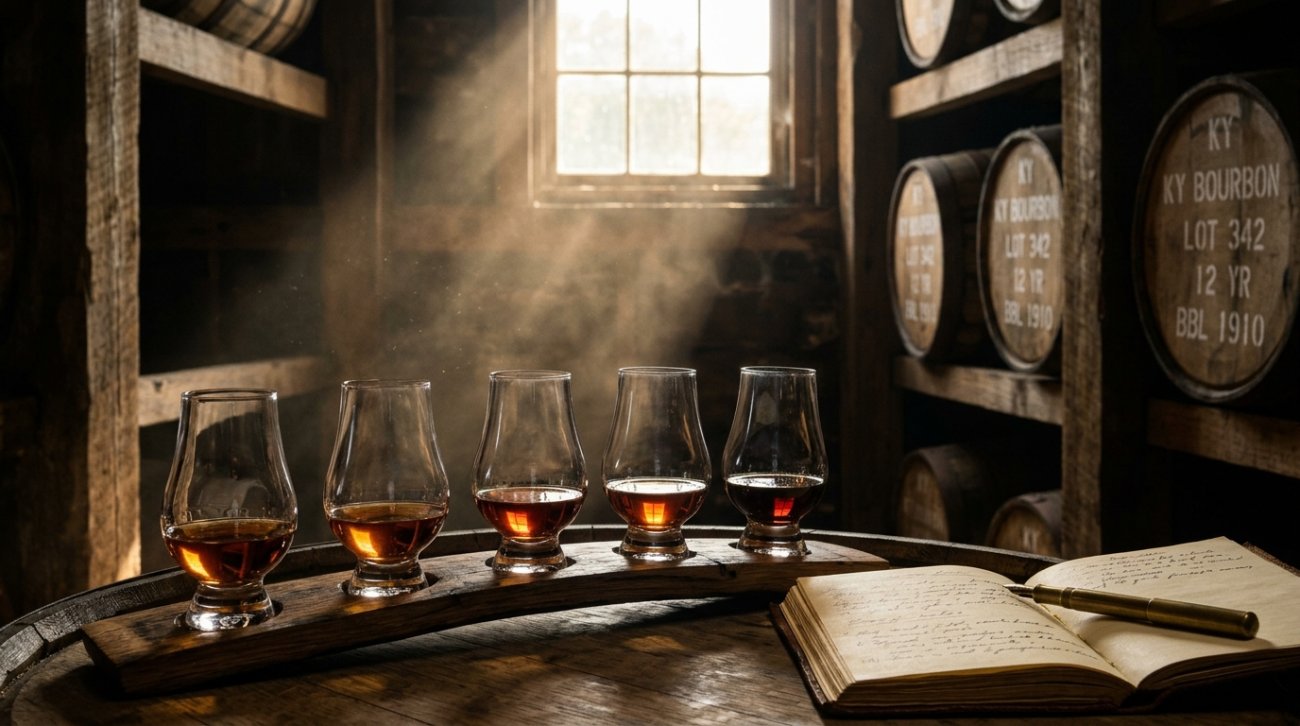
Pouring a fine bottle of allocated bourbon into a cheap, thick-rimmed soda glass is a sensory injustice. As demonstrated in studies published by Whisky Advocate and Glencairn Crystal Studio, the physical geometry of your glassware dictates fluid evaporation velocity, vapor separation, and where aromatic molecules make contact with olfactory receptors.
The Glencairn Glass: Analytical Tasting Standard
Designed by Raymond Davidson of Glencairn Crystal in 2001 and endorsed by the Scotch Whisky Association, the tulip-shaped Glencairn is the global benchmark for technical sensory evaluation:
- Tapered Chimney: Funnels delicate volatile aromatic esters (vanillins, lactones, floral ketones) directly toward the nose while diffusing aggressive ethanol sting.
- Wide Bowl: Provides optimal liquid surface area when swirling, promoting micro-oxygenation and releasing locked aromatic compounds.
- Solid Sturdy Base: Prevents body heat transfer from your fingers to the spirit, preserving the whiskey at ambient room temperature (65°F–68°F).
Heavy Cut-Crystal Rocks Glass: The Hospitality Pour
While unsuitable for formal proof analysis, a heavyweight double old fashioned (DOF) tumbler is indispensable for relaxed hospitality and on-the-rocks enjoyment:
- Heft & Tactile Luxury: A 12-to-14-ounce lead-free crystal tumbler with a weighted base provides undeniable presence in the hand.
- Large Sphere Compatibility: The wide cylindrical opening accommodates a dense 2.5-inch slow-melting clear ice sphere, chilling high-proof whiskey (like Weller Full Proof) with minimal water dilution.
- Classic Cocktails: Essential for crafting museum-grade Old Fashioneds, Boulevardières, and Sazeracs without overcrowding.
5. Decanter Storage, Headspace Oxidation & Cork Degradation
One of the most persistent misconceptions fueled by television and cinema is that mature whiskey should be poured into clear crystal decanters and left indefinitely on an open credenza. In reality, improper storage can destroy thousands of dollars in fine spirits within months.
The Truth About Decanters
Unlike vintage red wine—which requires decanting to separate sediment and rapidly breathe—whiskey does not benefit from long-term decanter storage. In fact, crystal decanters feature ground-glass stoppers rather than airtight hermetic seals. Over time, air drafts accelerate ethanol evaporation, causing the proof of your whiskey to drop and stripping away the spirit’s vibrant top notes. Furthermore, vintage antique crystal decanters manufactured prior to the 1980s often contain up to 30% lead oxide (PbO), which leaches into acidic alcohol within days. Only store whiskey in lead-free crystal decanters for short-term entertaining (under 2 to 3 weeks), or preserve the liquid in its original authenticated bottle.
Understanding Headspace & The Rule of Halves
When a bottle of rare whiskey like Old Fitzgerald 10 Year or Michter’s 10 Year is freshly opened, the ratio of air to liquid is roughly 1:10. Micro-oxidation during the first month often improves the spirit, rounding out hot edges. However, once a bottle drops below one-third full, the expanded oxygen volume aggressively oxidizes delicate flavor compounds, causing the whiskey to taste flat and cardboard-like within 6 to 12 months.
The Connoisseur Solution: When your luxury bottles dip below 30% capacity, either transfer the remaining spirit into 200ml Boston round sample bottles with poly-cone caps, or deploy food-grade argon/nitrogen inert gas spray (such as Wine Preserver or Private Preserve) to displace atmospheric oxygen before resealing.
The Vertical Storage Rule & Cork Care
High-proof spirits (45% to 65% ABV) act as aggressive organic solvents. If a whiskey bottle is stored horizontally like wine, the high-proof ethanol will rapidly dissolve the natural cork stopper. This results in cork rot, liquid leakage, and spoiled, spongy-tasting whiskey. As noted in secondary auction provenance reports from Sotheby’s Wine & Spirits Market Reports, cork degradation is the leading cause of value loss in collectible bottles. Always store whiskey strictly upright in a climate-stable room (58°F–68°F / 14°C–20°C) away from direct ultraviolet (UV) sunlight. Direct UV rays break down aromatic phenolic compounds and permanently bleach the whiskey’s natural oak coloration in under 90 days.
6. Frequently Asked Questions (FAQ)
How should I allocate a $5,000 budget for a luxury home whiskey bar?
The optimal allocation strategy dedicates 40% (~$2,000) to two or three allocated rare centerpieces (such as William Larue Weller or Pappy Van Winkle), 35% (~$1,750) to four to six daily premium connoisseur sippers (like Blanton’s Single Barrel, Michter’s 10, and Willett 8 Year), 15% (~$750) to transatlantic versatility (Macallan 18 or aged Irish whiskey), and 10% (~$500) to sommelier-grade crystal Glencairn glassware, heavy tumblers, and inert gas preservation tools.
Can I leave expensive bourbon in a crystal decanter permanently?
No. Ground-glass decanter stoppers do not create airtight seals. Over time, air infiltration causes ethanol evaporation and flavor flattening. Additionally, older antique decanters often contain lead oxide which leaches into the spirit. Only use lead-free crystal decanters for temporary service during entertaining events, and keep your primary collection stored in original airtight factory bottles.
Why do collectors use Glencairn glasses instead of rocks glasses?
The Glencairn glass features a distinct tulip-shaped inward taper that concentrates volatile aromatic compounds toward the nose while allowing harsh alcohol vapors to diffuse. Rocks glasses are ideal for casual drinking, ice spheres, and cocktails, but their wide open rim allows delicate wood sugars, esters, and subtle grain notes to escape into the room before they reach the palate.
How long does an opened bottle of luxury whiskey last?
An opened bottle of whiskey will remain in prime condition for 1 to 2 years if kept more than half full, upright, and out of direct sunlight. However, once the liquid drops below one-third of the bottle, increased headspace oxygen rapidly oxidizes aromatic esters. Connoisseurs recommend finishing the final third within 6 to 9 months or transferring the liquid into smaller airtight sample bottles.
Why must bourbon always be stored upright?
Bourbon is bottled at high proofs (40% to 65%+ ABV). Unlike wine, which requires moisture from horizontal storage to keep the cork expanded, high-proof spirits will chemically dissolve and disintegrate natural cork within months if left in continuous contact, ruining the whiskey’s flavor and destroying secondary collector value.



Add a review
Your email address will not be published. Required fields are marked *